


Sharing hard-won insights for harvest
Originally published by FarmWeekly, 8 October 2026.
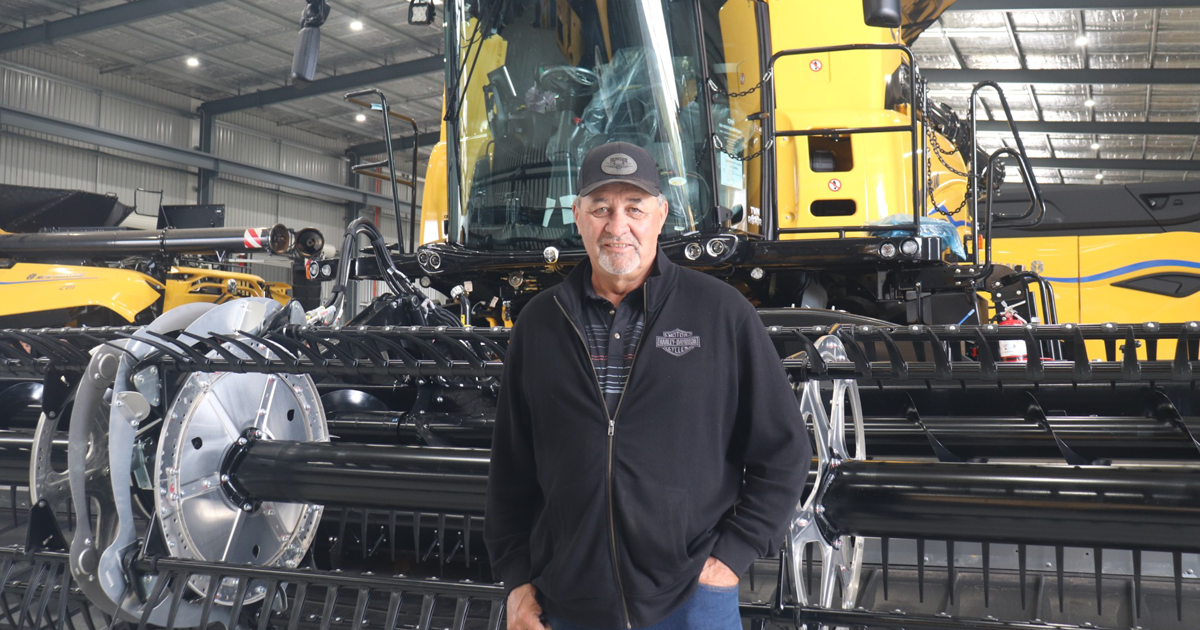
Independent harvest specialist, Murray Skayman, has decades of experience with setting up combines correctly.
Independent harves specialist Murray Skayman, stopped by McIntosh & Son's Wongan Hills branch to give grain producers and operators valuable and hard-won insight into New Holland combine harvesters.
Years before he was a machinery specialist, Mr Skayman was a grain producer in his home country, Canada, growing wheat, canola and barley.
"I had started growing peas in the 1970s, and that was my main moneymaker," Mr Skayman said.
"I also had a seed plant there, where I processed all of my grain; none of it went to the terminals."
For some time, it was a profitable venture for Mr Skayman, but years of inconsistent rainfall compelled him to call it quits and sell the farm.
Not long after, Case IH reached out and asked if he could help farmers set up their combines correctly.
What was pitched to him as a three-week gig became a 14-year career as a combine specialist, often splitting his time between Canada and Western Australia.
"Every time they call me here (WA), I know it's because something bad is going on," he said.
One reoccuring issue Mr Skayman noted was that farmers had a lot of trouble threshing wheat out.
"So I decided to see if I could make a concave that made it better," he said.
Mr Skayman wasted no time in constructing concaves; however, it became so time-consuming because he was building ones for New Holland and Case IH.
And then teh green guys (John Deere) got on my case, so I built some for them," he said.
Building concaves for all the major colours had been a full-time job for three years before Grains Research and Development Corporation (GRDC), asked him to be a part of their combine clinics.
Mr Skayman said he's noticed that WA grain producers are "getting to be very concerned about grain loss."
"Which they should, because that's just money that's being given away," he said.
"And so that's what I do: show them how to try and stop grain loss.
"But there's no one thing that cures it.
"You can't just wave a magic wand, because it could be a combination of factors, rasp bars, concaves, vanes, or even just general knowledge of how it works."
Knowing how the combine works is the biggest variable.
"If you know how it works, it's a lot easier to make adjustments," Mr Skayman said.

Grain producers and operators receiving valuable insight on New Holland combine harvesters at the McIntosh & Son, Wongan Hills branch.
When looking at the nuts and bolts of what leads to grain loss, though, Mr Skayman has recently been homing in on the vanes.
"It's really mind boggling," he said.
"Everyone thinks if you keep the vanes inside the combine longer, it has more time to thrash, and more time to get the grain out.
"Until you really experience it and see what happens, it functions in the complete opposite of what you think.
Mr Skayman said that when the vanes are in the fast position, it makes three rotations.
"The slow position goes around seven times," he said.
"And that sounds like it should be better to keep it all in there longer, but all it foes it pack the grain in there, and it won't let the grain out.
"It grinds all the straw while it's doing that, the longer the straw, the less loss you have, and now you're making the straw real short, and then you've got a big problem."
At that point, even automation won't be able to correct the issue.
"You have to be aware of that, and if you aren't, the losses can be huge," he said.
"I've seen losses higher than five per cent, in damp conditions."
Throughout his many presentations on setting up the vanes, Mr Skayman has noted a common reaction from grain producers and operators.
"You can see their eyes, and it's like a lightbulb goes on, and there's relief," he said.
"Because they had no idea; I didn't even have an idea myself, I learned the hard way."
For more information about New Holland Combines and our harvest demo program, please contact your local McIntosh & Son branch below.